
NEWS
Revised IMO guidelines for means of embarkation and disembarkation
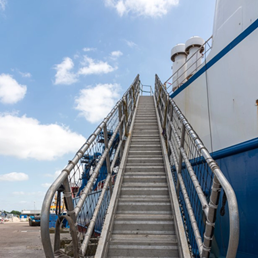
The International Maritime Organisation (IMO), through MSC.1/Circ.1331/Rev.1, has revised the following: Guidelines for the Construction, Installation, Maintenance and Inspection/Survey of Means of Embarkation and Disembarkation to bring them in line with the latest international standards and introduce clearer definitions and safety practices.
Applicability of ISO standards
The applicable ISO standard version for each type of means of (dis)embarkation is dependent on the date of equipment installation and the ship’s construction date.
The applicability of these standards is summarised in the table below:
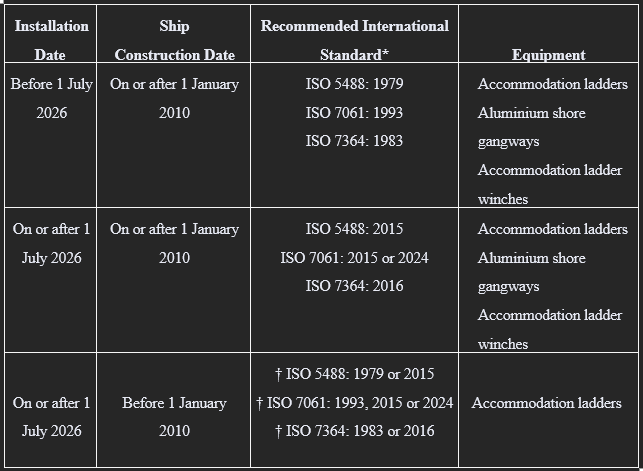
* and/ or national standards and/or other requirements recognised by the Administration.
† insofar as is reasonable and practicable.
New definitions
“Installed on or after 1 July 2026” means the date of: ship building contract or, in the absence of contract, the keel laying, or contractual date of equipment delivery or, in its absence, the actual delivery date of the equipment to the ship.
“Safety Net” is a net which is rigged between the ship's side and the means of (dis)embarkation to prevent a person from falling into the water or onto the quayside from a means of (dis)embarkation.
Mandatory safety practices
It has become mandatory for the crew to wear life jackets and safety harnesses while rigging the accommodation ladder, gangway and the safety net.
The revised guidelines have also introduced the possibility to use “side nets” on ladders as alternatives to a “safety net”. A safety net is not required if the hazard of falling through the sides of the means of embarkation and disembarkation is adequately mitigated by a top railing of rigid construction that is at least 1m high and a “side net” is rigged between this railing and the base of the accommodation ladder, including its upper and lower platforms.
The safety net and/or side nets must be regularly checked and maintained and, if deemed necessary, be replaced. They should be properly stored in ventilated places, avoiding sunlight and chemical contamination.
Testing of ladders and gangways
MSC.1/Circular.1331/Rev.1 includes amendments to clarify that:
- The five-yearly testing of accommodation ladders and gangways are done statically using the maximum working load.
- For the five-yearly testing of accommodation ladders, the winch should be operationally tested by raising and lowering the unloaded accommodation ladder.
- The tests should be carried out with the ladder or gangway in the horizontal position, and the accommodation ladder should be suspended by the wire(s) and supported by the winch.
Load testing guidance
For further guidance about load testing, please see MSC.1/Circular.1331/Rev.1 Section 5.3 “Tests”.
What should owners and operators do now?
Shipowners, ship operators, ship masters and officers, as well as manufacturers, are advised to familiarise themselves with the new guidelines and to train and instruct the crew accordingly.
For further information
Reference: https://www.lr.org/en/knowledge/class-news